Climate-Smart Design
Every solution is designed to keep working through floods, drought and heat, and to cut emissions along the sanitation chain.
Climate-smart by design
Climate damages sanitation. Floods wash pit and septic tank contents into homes and water sources, droughts leave flush toilets dry, heavy rain collapses unlined pits, and emptying trucks cannot reach flooded neighbourhoods.
Sanitation drives climate change. Excreta decomposing without oxygen in pits, tanks and drains releases methane. In Kampala, a whole-city study found sanitation produces about 189 kilotonnes of CO₂ equivalent a year, more than half of the city's emissions.
Source: Johnson et al. (2022), Communications Earth & Environment 3, 80.
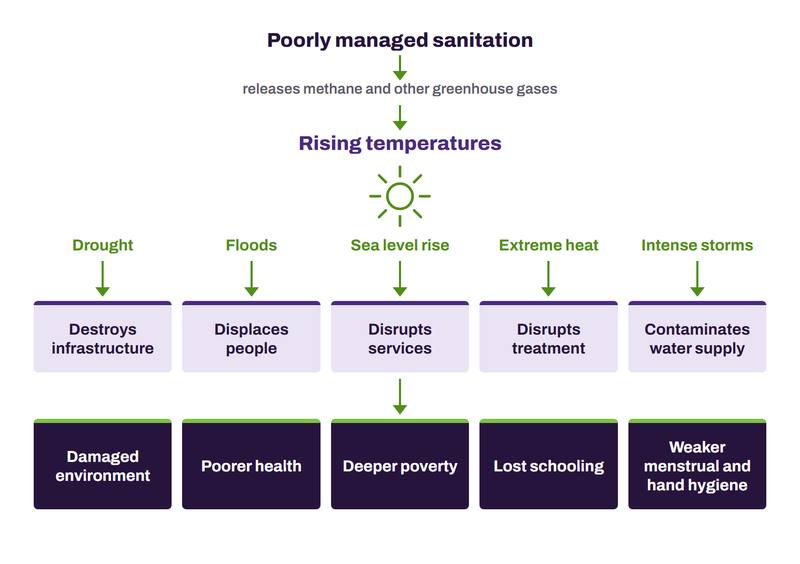
Adaptation: keep working through floods, drought and heat
- Avoid exposure: raised slabs and sealed, lined pits that floodwater cannot enter.
- Withstand it: precast linings that do not collapse in heavy rain.
- Need little water or power: dry and low-flush options, gravity-fed treatment.
- Recover fast: standard parts artisans can replace in days.
Mitigation: cut emissions along the sanitation chain
- Safely managed, not just built: sludge emptied, treated and reused.
- Capture methane: biogas that replaces firewood and charcoal.
- Compost instead of dumping: avoids methane, replaces synthetic fertiliser.
- Low-energy treatment: wetlands and baffled reactors that run mostly by gravity, with little or no electricity.
The climate case for each solution
Climate services for programmes and cities
Following the GWP and UNICEF framework for climate-resilient WASH: understand the problem, identify options, deliver solutions, and monitor.
Climate risk assessment
Hazards, exposure, vulnerability and capacity along the sanitation service chain.
Climate-resilient design
Design features that avoid, withstand and recover from floods, drought and heat.
Emissions estimates
Direct and indirect greenhouse gas emissions of sanitation options, to choose low-carbon designs.
Climate finance support
The technical and climate rationale for climate-finance proposals and programme design.
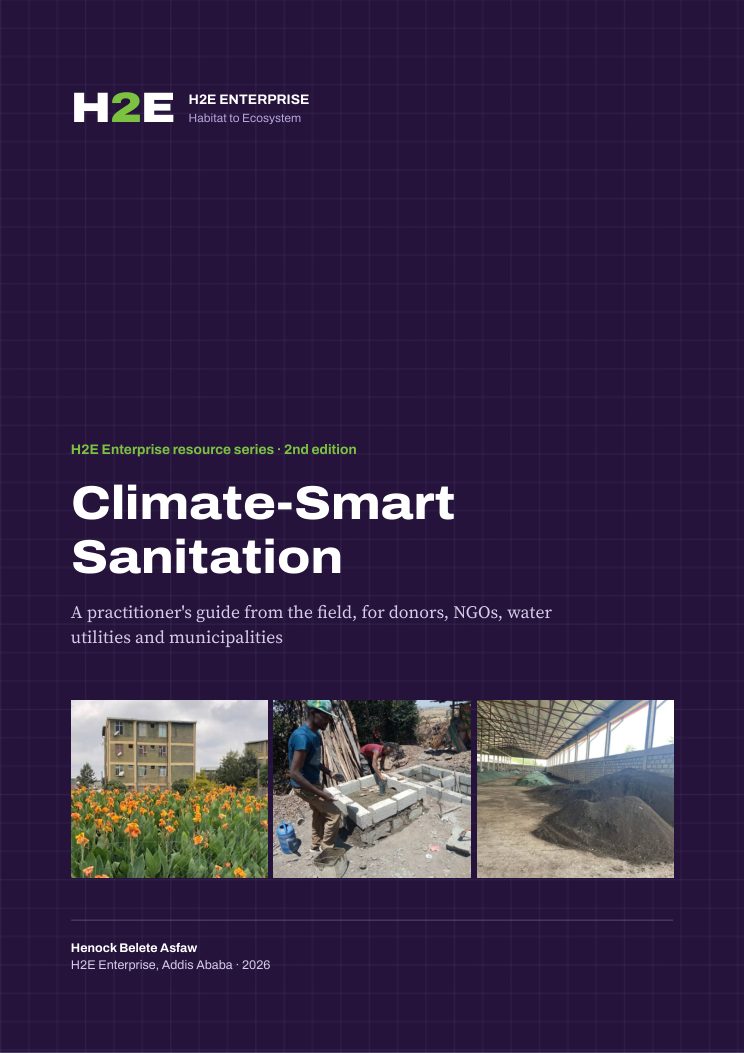
Climate-Smart Sanitation: A Practitioner's Guide from the Field
Our practical guide for donors, NGOs, water utilities and municipalities: climate hazard scorecards and emission estimates for eight sanitation, wastewater and resource recovery technologies, a tool for choosing the right option, and guidance on climate finance and monitoring.
Henock Belete Asfaw, H2E Enterprise. 2nd edition, 2026. PDF, 36 pages.
Bring a proven, climate-smart solution to your programme or city
We supply the design, tooling, training and delivery model, adapted to your context.